How to Start Learning French for Beginners

How to begin learning French for beginners is one of the most common concerns among those who wish to learn French. Learning French is an enjoyable experience, but at the same time, it can be challenging and intimidating. It is possible that you might be feeling confused and bewildered about how to get started, which areas to cover first, and how long it would take for you to be comfortable enough to converse in French.
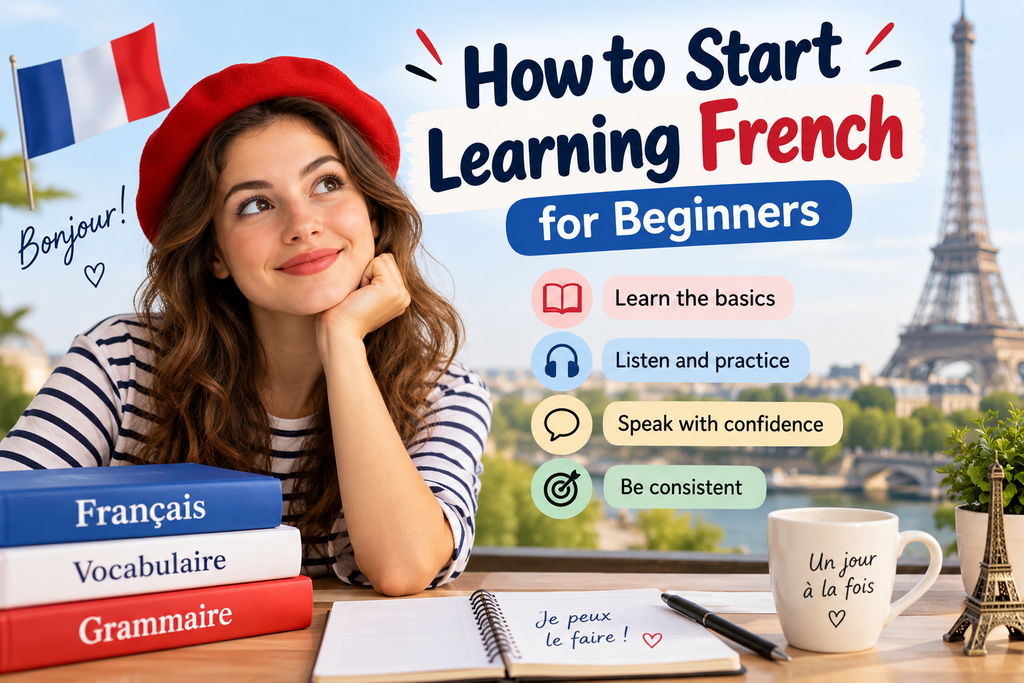
If you are wondering how to start learning French for beginners, focus on simple vocabulary, pronunciation, sentence formation, and regular practice.
The best thing is that you don’t need to cover all of the information at once. You can take it easy and gradually increase your French vocabulary and speaking abilities.
Why Learn French?
There are a lot of different reasons why someone would want to learn French.
It’s a beautiful language that’s used all around the world. It’s helpful for traveling, education, and can even be used at a job. Plus it allows you to enjoy French movies, music, books, food, and much more in an entirely new way.
Before you start, there’s only one question you need to ask yourself,
Why do I want to learn French?
Your answer can be your own motivation.
Think that you want to visit France, study abroad, broaden your professional skills, or simply learn a foreign language. Any specific purpose is a great motivation for any learner!
When you are a beginner, there is no point in trying to learn complex grammatical constructions.
First of all, you need to expand your arsenal of useful and simple French words with which you will be able to communicate every day.
For example, this includes such phrases as:
Bonjour – Hello
Merci – Thank you
Oui – Yes
Non – No
Au revoir – Goodbye
S’il vous plaît – Please
It seems that there is nothing difficult in this process, but, nevertheless, it works. Many students try to memorize hundreds of words at once, but this can be overwhelming. The best way to learn a foreign language is a little every day. The more often you visit the French language, even if only a few words, the more often it will be pleasant to repeat the experience.
Pay Attention to French Pronunciation
One thing that beginners often notice is that the pronunciation of the language can seem nothing like the spelling.
Do not be discouraged.
The easiest remedy is to simply familiarize yourself with the language.
Listen to the French, and repeat it out loud.
It does not matter whether the pronunciation will sound right or wrong to you at first.
The more you expose yourself to the language, the more you will be able to identify the different sounds and feel more confident speaking the language.
Build Your French Vocabulary Slowly
Vocabulary building is undoubtedly one of the most essential, yet underutilized tools in learning French, but you don’t need to memorize hundreds of words at a time.
It’s best to focus on sets of words relating to a single subject.
You can focus on these categories:
Family
Food
Home
Work
School
Travel
Shopping
Weather
Everyday activities
A good goal would be to learn five to ten French words at a time, and try to implement each word you learn into a sentence. This will greatly help you with long-term retention of the word, rather than just memorizing it from a textbook.
Make Simple French Sentences
As soon as you learn some words, start putting them together in very simple sentences.
Examples:
Je m’appelle Sara. My name is Sara.
J’aime le café. I like coffee.
J’habite en Inde. I live in India.
Don’t worry about making mistakes. Talking from the beginning will help you get more comfortable with the French language.
Practise French Every Day
You do not have to study for hours.
Study for 15-20 minutes every week or so for vocabulary, listening, speaking, or reading. Practicing more often is much more useful than spending a couple hours doing it all at once.
You can also incorporate it into your daily routine by listening to music or short videos in French or writing a couple sentences about your day.
Conclusion
Starting French is easier when you keep things simple
learn basic words, listen to it regularly, make sentences short and speak it out without being afraid of mistakes
Just take one step at a time and you will gradually be able to speak the language.